Mummies
From 19th November 2025 to 25th May 2026
Mummies
From 19th November 2025 to 25th May 2026
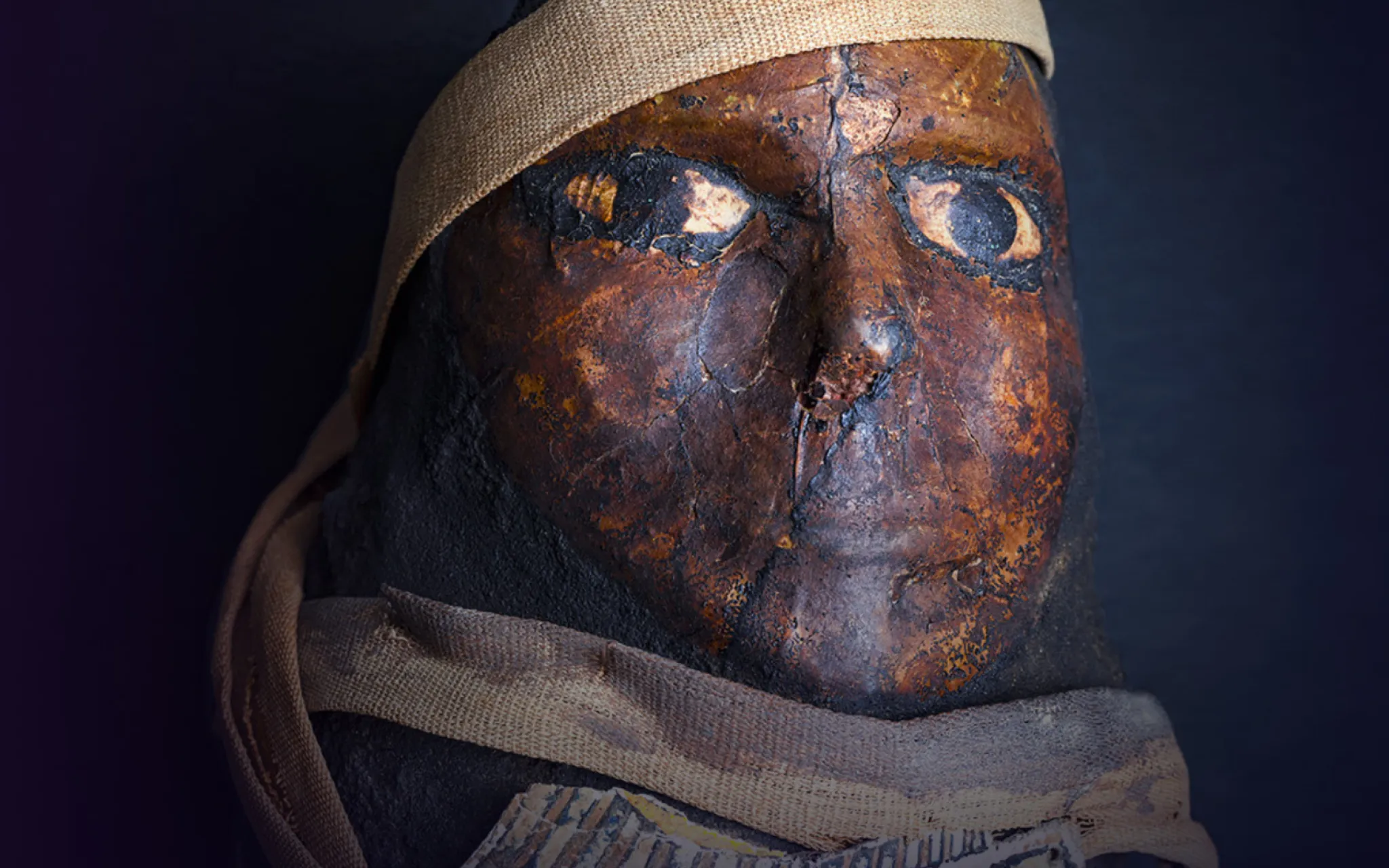
The mere mention of "mummies" conjures up images of ancient Egypt. However, mummification extends far beyond this specific time and place. This new exhibition explores the history of several mummified individuals, reveals the importance and diversity of this practice around the world, and examines the processes involved in preserving this heritage.
Intriguing, fascinating, sometimes terrifying, mummies have inspired countless works of art and literature. They appear in films, television series, books and comic books, where they are buried in tombs, hidden in golden sarcophagi, their bodies covered in worn bandages. This popularity has helped to forge an archetype of “the mummy” that freezes them in space and time, as the images that most often come to mind refer to ancient Egypt.
However, mummification is a practice that dates back much further! The oldest mummified bodies known to date are 9,000 years old and belong to the Chinchorros culture. Discovered in a territory located between present-day Peru and Chile, they are proof that this practice exists in different parts of the world.
Further evidence includes the mummified child found in 1756 in Martres-d'Artières, in the heart of the Auvergne countryside; the young queen of the Guanche culture from the Canary Islands; and the ‘Chachapoya mummy’ from the Peruvian Andes, which was exhibited at the Trocadéro Museum of Ethnography in 1878 and inspired the painter Edvard Munch for his famous painting The Scream.
Since ancient times, mummification has continued to this day, where it is still practised in many societies.
Warning
This exhibition features mummified human bodies that may evoke a range of emotions. We encourage you to have this in mind before visiting.
The exhibition
The exhibition invites you to encounter people who were intentionally mummified, whether in South America, Egypt, France or elsewhere, because although natural mummification does exist, the majority of people found mummified chose to be so. It also questions the place these individuals occupied within their societies, both before and after their mummification.
While the body is naturally destined to disappear, the exhibition invites you to explore the reasons that led so many cultures to opt for one of the most extreme practices in terms of preserving the body.
Presented lying down, sitting or crouching, naked, dressed or covered in bandages, these witnesses of the past, whose appearance differs from the usual clichés, provide us with clues as to how their bodies were transformed in order to survive the ages.
This highly codified process involved funeral specialists and was accompanied by a number of rites. Through a selection of emblematic objects, including funerary furniture, illustrations and educational displays, the exhibition introduces you to a wide variety of mummification techniques and rites.
Through previously unseen archives, the exhibition looks back at the rise of archaeology and the creation of museums in its wake. In the 19th century, archaeology was all the rage and excavations were carried out feverishly by the colonial powers. As a result, numerous mummified bodies were added to Western museum collections, arousing public curiosity, particularly during popular and highly publicised events.
Today, the approach has evolved: museums conduct provenance investigations and question the trajectory of these deceased individuals. This exhibition is an opportunity to showcase the ethical considerations that are being made, particularly at the Museum, around the issues of conservation and presentation.
Finally, the scientific study of mummified remains provides new insights into past lives. Who were they? What was their lifestyle? What did they look like? What was their physical condition before they died? Did they contract any diseases? What was their relationship with death? These are just some of the questions that research is exploring. Discover how scientists today are studying and reconstructing the lives of these mummified deceased individuals.
An Assassin's Creed educational touchscreen
For a better understanding of the Egyptian mummification process, the exhibition features an interactive device. Developed by Ubisoft based on the video game Assassin's Creed Origins and its educational mode Discovery Tour: Ancient Egypt, it allows to explore all the stages of mummification in 9 minutes, with informative video clips from the game. Each step is reconstructed with historical accuracy, based on research carried out by historians, archaeologists,
and Egyptologists, allowing to experience ancient Egyptian life.
Curators